
Projects
Selected work presented as structured, decision-focused case studies.
Each project page covers the business context, implementation approach, technical decisions, and delivery outcome. The aim is to show judgment, ownership, and execution quality rather than screenshots alone.
Project set
2 documented projects across product platforms, internal tools, and business-facing web experiences.
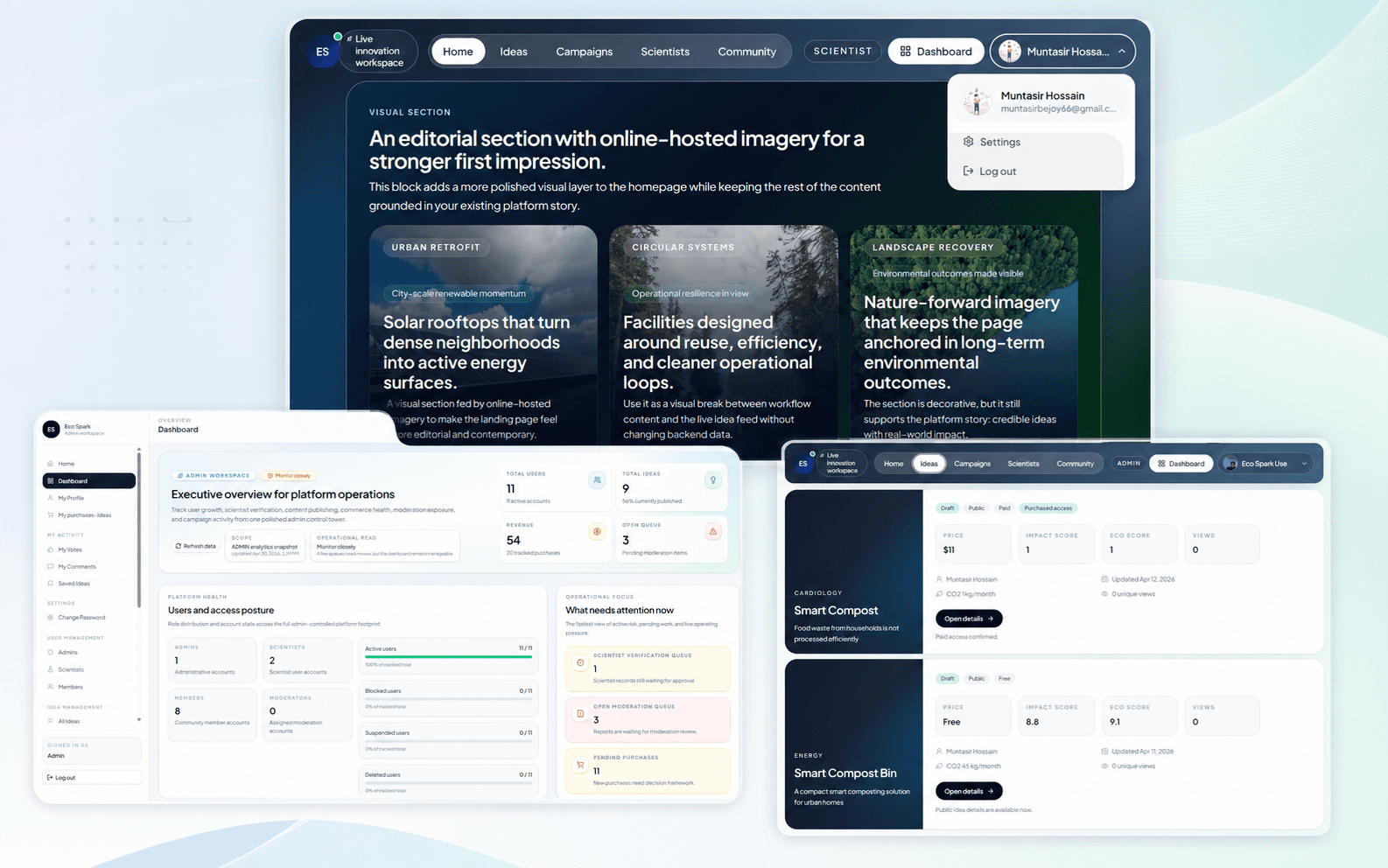


EcoSpark
A role-based sustainability platform where users can discover eco ideas, manage campaigns, access premium innovation content, and collaborate around environmental solutions.
Problem: Sustainability-focused communities often lack a structured digital platform where members, contributors, and admins can manage eco ideas, campaigns, collaboration, and paid knowledge access in one consistent workflow.
Solution: I built a modern frontend architecture using Next.js, React, TypeScript, TanStack Query, TanStack Form, Zod, Axios, and Tailwind CSS. The application separates public discovery from authenticated workspace flows and connects with a backend API for role-based platform features.
Impact: The project creates a scalable frontend foundation for sustainability communities, improving idea discovery, campaign visibility, role-based access, and user interaction across the platform.
Audience: Eco-conscious users, sustainability contributors, campaign organizers, moderators, admins, and users interested in premium innovation ideas.
Access: Public GitHub repository with deployed frontend and connected backend API.



Frontend commits
43
Role-based flows
Multiple
Deployment
Vercel

SkillSync AI
A full-stack AI learning management platform that connects course discovery, role-based dashboards, progress tracking, support, notifications, and practical AI learning workflows.
Problem: Learners often depend on disconnected tools for courses, progress tracking, assignments, feedback, support, and AI planning. This creates friction because learning goals, course activity, feedback, and career guidance are not connected in one coherent system.
Solution: I built a full-stack platform with a Next.js frontend and a modular Express backend. The frontend delivers a polished SaaS-style experience with role-aware dashboards, validated forms, server-state management, and structured AI result rendering. The backend provides secure APIs for LMS workflows, JWT authentication, RBAC, Prisma/PostgreSQL data modeling, transactional email, notifications, analytics, and real Gemini AI integrations.
Impact: The project demonstrates end-to-end product engineering: a real AI-enabled learning platform with user roles, secure backend architecture, connected LMS workflows, production-ready UI states, and AI features that support practical learning decisions instead of acting as decorative demo buttons.
Audience: Students, instructors, admins, online learning platforms, career-focused learners, and teams building AI-assisted education products.
Access: Public GitHub repositories with deployed frontend and backend. Demo credentials are available in the project README for student, instructor, and admin roles.








Frontend commits
16
Backend commits
25
User roles
3